| anytool | ||
| assets | ||
| atb_data | ||
| misc | ||
| preprocess | ||
| scripts | ||
| toolbench | ||
| arguments.py | ||
| config_example.py | ||
| LICENSE | ||
| openai_utils.py | ||
| rapidapi_key_list_example.json | ||
| README.md | ||
| requirements.txt | ||

AnyTool



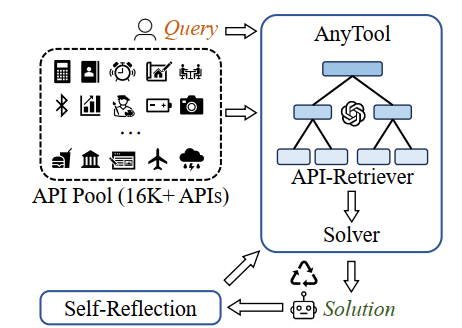
This is the implementation of the paper AnyTool: Self-Reflective, Hierarchical Agents for Large-Scale API Calls
🔧 Installation
✅ Dependencies
Require Python 3.9+
🚀 Quick install
pip install -r requirements.txt
🔆 Preparation
OPENAI API config and the ToolBench key
Fill your OpenAI GPT-4 API config and toolbench key into the config.py (see config_example.py). We use Azure OpenAI for all our experiments. You can modify it according to your own configuration.
Fill out the form to get the toolbench key. If you want to use your own RapidAPI key, you can put your key in the rapidapi_key_list.json
ToolBench
Download the ToolBench data using the following link: Google Drive or Tsinghua Cloud.
The file structure is as follows:
├── /data/
│  ├── /instruction/
│  ├── /answer/
│  ├── /toolenv/
│  ├── /retrieval/
│  ├── /test_instruction/
│  ├── /test_query_ids/
│  ├── /retrieval_test_query_ids/
│  ├── toolllama_G123_dfs_train.json
│  └── toolllama_G123_dfs_eval.json
├── /reproduction_data/
│  ├── /chatgpt_cot/
│  ├── /chatgpt_dfs/
│  ├── ...
│  └── /toolllama_dfs/
For more details, please refer to ToolBench.
Prepare the API data
You should prepare the ToolBench data first. Make sure you have the directory of data/toolenv/tools
export PYTHONPATH=./
python scripts/extract_api_details.py
python scripts/extract_category_tool_details.py
python scripts/extract_tool_database.py
AnyToolBench
Generation script
export PYTHONPATH=./
python scripts/anytoolbench_generation.py --output_path atb_data/anytoolbench_new.json
We provide sample data in anytoolbench.json file.
The data look like
"query": "Can you provide detailed information about \"The Incredible Hulk\" movie that was released in 2008, including its plot, genres, and how it's evaluated by audiences, and also tell me the current timezone for Los Angeles, USA?",
"final_answer": "The Incredible Hulk (2008) is about scientist Bruce Banner who searches for an antidote to his unbridled rage, the Hulk, but faces new foes when forced back to civilization. GENRES: Sci-Fi, Action, Adventure. AUDIENCE SCORE: 6.2/10. The current timezone for Los Angeles, USA, is America/Los_Angeles.",
"query_id": "1000006",
"gt_api_list": [
            {
                "category_name": "Movies",
                "tool_name": "Advanced Movie Search",
                "api_name": "Search by Name"
            },
            {
                "category_name": "Location",
                "tool_name": "Timezone By API-Ninjas",
                "api_name": "/v1/timezone"
            }
        ],
🚗 Run AnyTool
Experiment on ToolBench, take G1-I as an example.
export PYTHONPATH=./
python scripts/main.py --output_dir result/test_instruction/G1_instruction --query_path data/test_instruction/G1_instruction.json --max_api_number 64
Experiment on AnyToolBench
export PYTHONPATH=./
python scripts/main.py --output_dir result/anytoolbench --query_path anytoolbench.json -max_api_number 64
The pass rate can be found in the success_cnt.txt under the output directory.
👨🏫 Acknowledgement
This repo is built on ToolBench.
📑Citation
If you find this project is helpful for your research, consider citing our paper
@article{du2024anytool,
  title={AnyTool: Self-Reflective, Hierarchical Agents for Large-Scale API Calls},
  author={Du, Yu and Wei, Fangyun and Zhang, Hongyang},
  journal={arXiv preprint arXiv:2402.04253},
  year={2024}
}