 cb66ad17cc
Skills go stale as APIs change and data sources move. This adds a three-layer staleness detection system: review date tracking with git fallback, HTTP health checks for declared dependencies, and top-level key comparison for schema drift. All new frontmatter fields are optional — existing skills work unchanged. Co-Authored-By: Claude Opus 4.6 <noreply@anthropic.com> |
||
|---|---|---|
| Dynamous | ||
| exports | ||
| references | ||
| registry | ||
| scripts | ||
| .gitignore | ||
| README.md | ||
| SKILL.md | ||
Agent Skill Creator
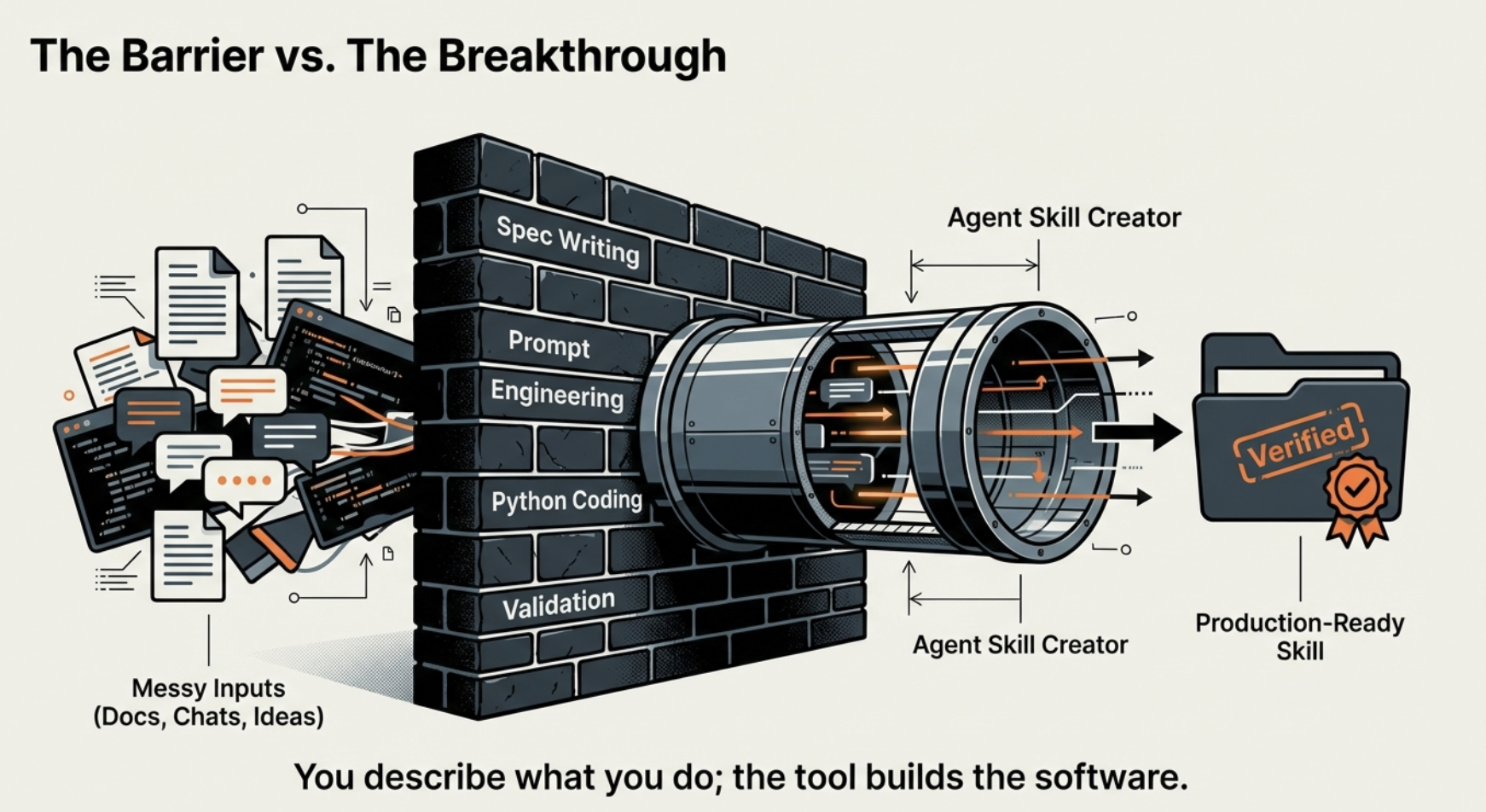
Turn any workflow into reusable AI agent software — no spec writing, no prompt engineering, no coding required.



The Problem
Every AI agent (Claude Code, GitHub Copilot, Cursor, Windsurf, Codex, Gemini) starts from zero. It doesn't know your company's processes, data sources, or compliance requirements. So every person re-explains the same workflows in every conversation. Knowledge stays in individual chat histories. New hires start from scratch.
Agent skills fix this. A skill is structured knowledge your agent loads automatically — like installing an app. Once installed, anyone on your team can invoke it and get consistent results, every time, on any platform.
The catch: building a proper skill requires understanding the spec format, writing clear prompt instructions, designing how information loads progressively, writing functional code, and getting activation keywords right. Even simple skills take multiple rounds of iteration to get right.
Agent Skill Creator removes that barrier entirely. You pass in whatever you have — messy docs, links, code, PDFs, transcripts, vague descriptions — and it produces a validated, security-scanned skill ready to install and share. You describe what you do; it builds the software.
Quick Start
1. Install (one command)
# Claude Code (global — works in all projects)
git clone https://github.com/FrancyJGLisboa/agent-skill-creator.git ~/.claude/skills/agent-skill-creator

# VS Code with GitHub Copilot (global — works in all projects, requires VS Code 1.108+)
git clone https://github.com/FrancyJGLisboa/agent-skill-creator.git ~/.claude/skills/agent-skill-creator

# Cursor (per-project)
git clone https://github.com/FrancyJGLisboa/agent-skill-creator.git .cursor/rules/agent-skill-creator
Claude Code and VS Code Copilot share the same global path (~/.claude/skills/) — one install works for both. Cursor requires per-project install; see global workaround.
Other platforms: see full list below.
2. Use it
Open your agent and type /agent-skill-creator followed by whatever you have:
/agent-skill-creator Every week I pull sales data from our CRM, clean
duplicate entries, calculate regional totals, and generate a PDF report.
You can pass anything — plain English, documentation links, existing code, API docs, PDFs, database schemas, transcripts. Combine multiple sources in one message. The more context, the better the result.
/agent-skill-creator Based on our deployment runbook: https://wiki.internal/deploy-process
/agent-skill-creator See scripts/invoice_processor.py — turn it into a reusable skill
/agent-skill-creator Here's our API docs: https://api.internal/docs
Create a skill that queries stock levels and generates reorder reports.
3. What comes out
A complete skill, automatically installed on your platform:
Skill installed successfully.

To use it, open a new session and type:

  /sales-report-skill Generate the weekly report for the West region

Installed at: ~/.claude/skills/sales-report-skill
The agent detects your platform (Claude Code, Cursor, Copilot, etc.), installs the skill to the right location, and tells you exactly how to invoke it. No manual steps.
The generated skill directory looks like this:
sales-report-skill/
├── SKILL.md          # Skill definition (activates with /sales-report-skill)
├── scripts/          # Functional Python code
├── references/       # Detailed documentation
├── assets/           # Templates, configs
├── install.sh        # Cross-platform installer (for sharing with others)
└── README.md         # Installation instructions (for sharing with others)
Your team installs it the same way they installed agent-skill-creator — one git clone — and invokes it with /sales-report-skill. The included install.sh auto-detects their platform too.
How It Works
You don't need to understand any of this to use it. But if you're curious:
The agent doesn't just follow your description literally. Humans describe what they do, not what they need. "I pull sales data and make a report" hides a dozen implicit requirements — who reads the report, what format, what happens when data is missing. The agent reads all your material, uncovers these implicit requirements, and generates its own internal specification before writing any code. It builds from that deeper understanding, not from your surface description.
UNDERSTAND    Read all material → uncover real intent → generate internal spec
BUILD         Structure directory → write code and docs → craft activation keywords
VERIFY        Spec validation → security scan → block delivery if either fails
Every skill is automatically validated (correct structure, naming, metadata) and security-scanned (no hardcoded keys, no credential exposure, no injection risks) before delivery. Skills that fail these checks are blocked.
Share Skills Across Your Team
After the agent builds and installs your skill, it asks:
Want to share this skill with your team so they can install it too?
Say yes. The agent detects whether your team uses GitHub or GitLab, creates a repo, pushes the skill, and gives you a one-liner to share:
Shared! Your colleagues can install it by pasting this in their terminal:

  git clone https://github.com/your-org/sales-report-skill.git ~/.claude/skills/sales-report-skill
or for GitLab teams:
git clone https://gitlab.com/your-org/sales-report-skill.git ~/.claude/skills/sales-report-skill
Send that line to your colleague on Slack or Teams. They paste it. Done. They can now type /sales-report-skill in their agent.
No registry commands, no publishing steps, no terminal knowledge beyond paste. The agent handles the repo creation, the push, and generates install commands for every platform. Works with GitHub, GitLab, GitHub Enterprise, and self-hosted GitLab instances.
The result over time
Each team member creates skills from their own domain and shares them. Over months the organization accumulates a library of reusable skills:
- Sales team shares
/sales-report-skill - Engineering shares
/deploy-checklist-skill - Legal shares
/quarterly-compliance-skill - Data science shares
/customer-churn-skill - SRE shares
/incident-runbook-skill
Any colleague installs any skill with one git clone. Any agent on any platform can invoke it. Knowledge compounds instead of evaporating.
For teams and consultants: the skill registry
When an organization has more than a few skills, the agent offers to set up a team skill registry — a shared git repo where all team members publish their skills and anyone can browse and install them.
The consultant (or team lead) sets it up once:
python3 scripts/skill_registry.py init --name "Acme Corp Skills"
Then every team member can:
# Publish a skill they created
python3 scripts/skill_registry.py publish ./sales-report-skill/ --tags sales,reports

# Browse what's available
python3 scripts/skill_registry.py list

# Search for a specific skill
python3 scripts/skill_registry.py search "sales"

# Install a colleague's skill (auto-detects VS Code Copilot, Cursor, etc.)
python3 scripts/skill_registry.py install sales-report-skill
The registry is a git repo on GitHub or GitLab. Clone it once, and every team member can publish and install. No servers, no databases — just git.
For AI consultants: The engagement model is teach, not build. Install agent-skill-creator on each team member's machine, create the shared {team}-skills-registry repo, teach the team the 5-step workflow (install, clone registry, create skill, publish, install from registry), and hand over a self-sustaining system. After you leave, the team keeps creating and sharing skills on their own. They know their workflows better than you do — your job is to remove the friction.
All Platforms
Works in IDEs and CLI tools. Same install, same invocation, same results.
Global install (available in all projects)
These platforms support a global user-level skills directory. Install once, use in every project:
# Claude Code + VS Code Copilot (same path works for both)
git clone https://github.com/FrancyJGLisboa/agent-skill-creator.git ~/.claude/skills/agent-skill-creator

# Also works via the Copilot-specific global path
git clone https://github.com/FrancyJGLisboa/agent-skill-creator.git ~/.copilot/skills/agent-skill-creator
VS Code Copilot (1.108+, December 2025) adopted the Agent Skills Open Standard and searches ~/.claude/skills/ and ~/.copilot/skills/ by default. One install at ~/.claude/skills/ makes a skill globally available on both Claude Code and VS Code Copilot.
Per-project install
For platforms without a global skills directory, or if you prefer per-project installation:
# VS Code with GitHub Copilot (per-project alternative)
git clone https://github.com/FrancyJGLisboa/agent-skill-creator.git .github/skills/agent-skill-creator

# Windsurf
git clone https://github.com/FrancyJGLisboa/agent-skill-creator.git .windsurf/skills/agent-skill-creator

# Cline (VS Code Extension)
git clone https://github.com/FrancyJGLisboa/agent-skill-creator.git .clinerules/agent-skill-creator
Cursor — global install
Cursor does not have a global skills directory. Clone once and symlink per project:
# 1. Clone once
git clone https://github.com/FrancyJGLisboa/agent-skill-creator.git ~/agent-skills/agent-skill-creator

# 2. In any project, symlink
mkdir -p .cursor/rules && ln -s ~/agent-skills/agent-skill-creator .cursor/rules/agent-skill-creator
Add a shell alias to automate this (~/.zshrc or ~/.bashrc):
alias install-skills='mkdir -p .cursor/rules && ln -s ~/agent-skills/agent-skill-creator .cursor/rules/agent-skill-creator'
Then in any project: install-skills. Updates propagate automatically via the symlink.
CLI Tools
# Claude Code (global — available in all projects)
git clone https://github.com/FrancyJGLisboa/agent-skill-creator.git ~/.claude/skills/agent-skill-creator

# GitHub Copilot CLI
git clone https://github.com/FrancyJGLisboa/agent-skill-creator.git ~/.copilot/skills/agent-skill-creator

# OpenAI Codex CLI
git clone https://github.com/FrancyJGLisboa/agent-skill-creator.git .codex/skills/agent-skill-creator

# Gemini CLI
git clone https://github.com/FrancyJGLisboa/agent-skill-creator.git .gemini/skills/agent-skill-creator
Claude Desktop / claude.ai
python3 scripts/export_utils.py ./agent-skill-creator/ --variant desktop
# Then: Settings > Skills > Upload the generated .zip
Update
cd ~/.claude/skills/agent-skill-creator && git pull
Quality Gates
Every skill goes through automated checks before delivery and on every publish:
| Gate | What It Checks |
|---|---|
| Spec Validation | SKILL.md structure, frontmatter format, naming rules, file references |
| Security Scan | No hardcoded API keys, no credentials, no injection patterns |
| Staleness Check | Review dates, dependency health, API schema drift |
Run them independently anytime:
python3 scripts/validate.py ./my-skill/
python3 scripts/security_scan.py ./my-skill/
python3 scripts/staleness_check.py ./my-skill/
python3 scripts/staleness_check.py ./my-skill/ --check-deps --check-drift
Skills that fail validation cannot be published. Skills with high-severity security issues are blocked.
Staleness Detection
Skills go stale. APIs change, compliance rules update, data sources move. A skill that worked six months ago may silently produce wrong results today. Staleness detection surfaces this before users hit it.
Three layers, each opt-in:
Review tracking — Every skill can declare when it was last reviewed and how often it should be. The staleness checker compares these dates and flags overdue skills. Skills without explicit dates fall back to the last git commit date on SKILL.md.
python3 scripts/staleness_check.py ./my-skill/
# Exit code 0 = fresh, 1 = overdue for review
Dependency health — Skills can declare external URLs they depend on (APIs, data sources). The --check-deps flag HTTP-checks each one and reports failures.
python3 scripts/staleness_check.py ./my-skill/ --check-deps
# Exit code 2 = one or more dependencies unreachable
Schema drift — Skills can declare the expected top-level keys in API responses. The --check-drift flag fetches each endpoint and compares actual keys against expected. Missing keys = the API changed under you.
python3 scripts/staleness_check.py ./my-skill/ --check-drift
All three layers are controlled by optional frontmatter fields. Existing skills work unchanged — the tool just suggests adding the metadata:
metadata:
  created: 2026-02-27
  last_reviewed: 2026-02-27
  review_interval_days: 90
  dependencies:
    - url: https://api.example.com/v1
      name: Example API
      type: api
  schema_expectations:
    - url: https://api.example.com/v1/data
      method: GET
      expected_keys:
        - id
        - price
        - volume
For teams using the skill registry, stale scans every published skill at once:
python3 scripts/skill_registry.py stale
# NAME            VERSION  STATUS   DAYS SINCE  SOURCE          INTERVAL
# sales-report    1.2.0    OVERDUE  127         last_reviewed   90
# deploy-check    2.0.1    FRESH    12          published       90
Tools Reference
Registry Commands
python3 scripts/skill_registry.py init --name "Acme Corp Skills"     # First-time setup
python3 scripts/skill_registry.py publish ./skill/ --tags t1,t2      # Publish a skill
python3 scripts/skill_registry.py list                                # Browse all skills
python3 scripts/skill_registry.py search "query"                     # Search skills
python3 scripts/skill_registry.py info skill-name                    # Skill details
python3 scripts/skill_registry.py install skill-name                 # Install a skill
python3 scripts/skill_registry.py remove skill-name --force          # Remove a skill
python3 scripts/skill_registry.py stale                              # Report stale skills
python3 scripts/skill_registry.py stale --json                       # Machine-readable output
Validation, Security, and Staleness
python3 scripts/validate.py ./skill/               # Spec compliance
python3 scripts/validate.py ./skill/ --json         # Machine-readable output
python3 scripts/security_scan.py ./skill/           # Security audit
python3 scripts/security_scan.py ./skill/ --json    # Machine-readable output
python3 scripts/staleness_check.py ./skill/                      # Review staleness
python3 scripts/staleness_check.py ./skill/ --check-deps         # + dependency health
python3 scripts/staleness_check.py ./skill/ --check-drift        # + schema drift
python3 scripts/staleness_check.py ./skill/ --json               # Machine-readable output
Export
python3 scripts/export_utils.py ./skill/ --variant desktop    # For Claude Desktop
python3 scripts/export_utils.py ./skill/ --variant api        # For Claude API
All commands use exit code 0 for success, 1 for errors. All support --json for CI/CD integration.
Troubleshooting
Skill not activating: Check that the SKILL.md description field contains keywords matching your query. The description is how the agent decides when to activate the skill.
Validation fails on name: Names must be lowercase, use hyphens between words, 1-64 characters. Examples: sales-report-skill, deploy-checklist.
SKILL.md too long: Move detailed content to references/ files and link from the main SKILL.md.
Platform not auto-detected: Use --platform cursor (or copilot, windsurf, etc.) to specify explicitly.
Project Structure
agent-skill-creator/
  SKILL.md                      # The skill definition (what the agent reads)
  README.md                     # This file
  scripts/
    validate.py                 # Spec compliance checker
    security_scan.py            # Security scanner
    staleness_check.py          # Staleness detection (review, deps, drift)
    export_utils.py             # Cross-platform export
    skill_registry.py           # Team skill registry
    install-template.sh         # Template for generated installers
  references/                   # Detailed docs (loaded by the agent on demand)
    pipeline-phases.md          # Full creation pipeline
    architecture-guide.md       # Skill structure decisions
    quality-standards.md        # Code and documentation standards
    multi-agent-guide.md        # Multi-skill suite creation
    cross-platform-guide.md     # Platform compatibility
    export-guide.md             # Export documentation
    templates-guide.md          # Template system
    interactive-mode.md         # Interactive wizard
    agentdb-integration.md      # Learning system
    phase1-discovery.md         # Phase 1 deep dive
    phase2-design.md            # Phase 2 deep dive
    phase3-architecture.md      # Phase 3 deep dive
    phase4-detection.md         # Phase 4 deep dive
    phase5-implementation.md    # Phase 5 deep dive
    templates/                  # Skill templates
    examples/stock-analyzer/    # Example skill
  registry/                     # Shared skill catalog
    registry.json
    skills/
  exports/                      # Export output
Contributing
- Fork the repository
- Create a feature branch
- Make your changes
- Run
python3 scripts/validate.py ./andpython3 scripts/security_scan.py ./ - Submit a pull request
License
MIT