 d7b0fff954
Creates the API layer for Open Notebook
Creates a services API gateway for the Streamlit front-end
Migrates the SurrealDB SDK to the official one
Change all database calls to async
New podcast framework supporting multiple speaker configurations
Implement the surreal-commands library for async processing
Improve docker image and docker-compose configurations
19 KiB





Open Notebook
An open source, privacy-focused alternative to Google's Notebook LM!
Join our Discord server for help, to share workflow ideas, and suggest features!
Checkout our website »
Get Started (Setup)
·
Features
📢 Open Notebook is under very active development
Open Notebook is under active development! We're moving fast and making improvements every week. Your feedback is incredibly valuable to me during this exciting phase and it gives me motivation to keep improving and building this amazing tool. Please feel free to star the project if you find it useful, and don't hesitate to reach out with any questions or suggestions. I'm excited to see how you'll use it and what ideas you'll bring to the project! Let's build something amazing together! 🚀
Installation Issues?
We have a CustomGPT built to help you install Open Notebook. Check it out here. It will help you through each step of the process.
There are also some basic docker/openai installation guide available if you prefer to install it manually.
Table of Contents
About The Project
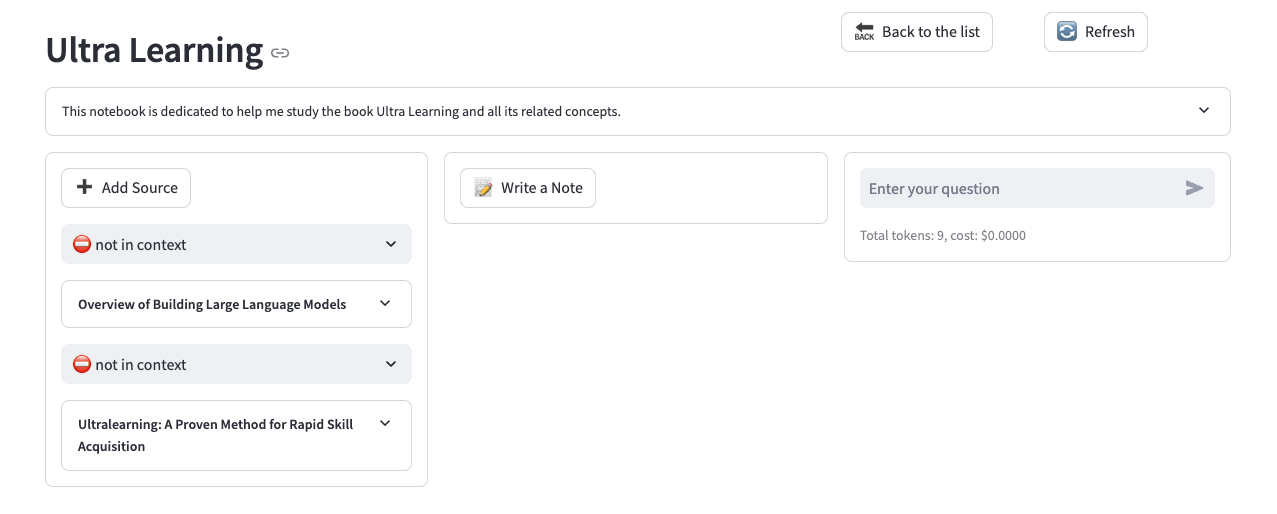
An open source, privacy-focused alternative to Google's Notebook LM. Why give Google more of our data when we can take control of our own research workflows?
In a world dominated by Artificial Intelligence, having the ability to think 🧠 and acquire new knowledge 💡, is a skill that should not be a privilege for a few, nor restricted to a single provider.
Open Notebook empowers you to manage your research, generate AI-assisted notes, and interact with your content—on your terms.
Learn more about our project at https://www.open-notebook.ai
Built With




⚙️ Setting Up
Go to the Setup Guide to learn how to set up the tool in details.
📚 Need help choosing AI models? Check out our Model Selection Guide for recommended combinations and provider comparisons.
You don't need to clone this repo if you just want to use the app without building from source! Take a look at the Open Notebook Boilerplate repo with a sample of how to set it up for maximum feature usability.
Running from source
Start by cloning this repo and cd into it.
git clone https://github.com/lfnovo/open-notebook
cd open-notebook
Rename .env.example into .env and set up your API keys.
Also, repeat the process for docker.env if you plan to run this using docker.
cp .env.example .env
cp .env.example docker.env
Edit .env for your API keys.
🔐 Password Protection (Optional)
For users hosting Open Notebook publicly (e.g., on PikaPods, cloud services), you can protect your instance with a password:
# Add this to your .env file
OPEN_NOTEBOOK_PASSWORD=your_secure_password_here
When this environment variable is set:
- Streamlit UI: Users must enter the password on first access
- REST API: All API calls require the password in the Authorization header (
Authorization: Bearer your_password) - Local Usage: If not set, no authentication is required (default behavior)
API Usage with Password:
# Example API call with password
curl -H "Authorization: Bearer your_password" http://localhost:5055/api/notebooks
This provides basic protection for public deployments while keeping local usage simple and password-free.
📚 For detailed security information, see the Security Guide.
🚀 Quick Start
After setting up your environment, simply run:
make start-all
This single command will start all required services (database, API, worker, and UI) for you!
System Dependencies
This project requires some system dependencies:
# macOS
brew install libmagic

# Ubuntu/Debian
sudo apt-get install libmagic-dev

# Fedora/RHEL/CentOS
sudo dnf install file-devel
Installing Python Dependencies
Install all required Python packages:
uv sync
uv pip install python-magic
Running the Application
Open Notebook now requires four services to run: the database, API backend, worker, and Streamlit interface.
✨ Easiest Way: Use make start-all
After completing the setup above, the recommended way to run Open Notebook is:
make start-all
This single command will:
- Start SurrealDB database on port 8000
- Start FastAPI backend on port 5055
- Start Background Worker for podcast generation and transformations
- Start Streamlit UI on port 8502
Once running, access Open Notebook at http://localhost:8502 🎉
Manual Setup (Development)
If you prefer to start services individually:
# 1. Start SurrealDB database
make database
# or: docker compose up -d surrealdb

# 2. Start the FastAPI backend (in terminal 1)
make api
# or: uv run --env-file .env uvicorn api.main:app --host 0.0.0.0 --port 5055

# 3. Start the background worker (in terminal 2)
make worker
# or: uv run --env-file .env surreal-commands-worker --import-modules commands

# 4. Start Streamlit UI (in terminal 3)
make run
# or: uv run --env-file .env streamlit run app_home.py
Service Endpoints
- Streamlit UI:
http://localhost:8502 - REST API:
http://localhost:5055 - API Documentation:
http://localhost:5055/docs(Interactive Swagger UI) - SurrealDB:
http://localhost:8000
Service Management
# Check if all services are running
make status

# Stop all services
make stop-all

# Restart worker only
make worker-restart
Note: The worker is required for podcast generation and content transformations. Without it, these features will queue jobs but not process them.
Provider Support Matrix
Thanks to the Esperanto library, we support this providers out of the box!
| Provider | LLM Support | Embedding Support | Speech-to-Text | Text-to-Speech |
|---|---|---|---|---|
| OpenAI | ✅ | ✅ | ✅ | ✅ |
| Anthropic | ✅ | ❌ | ❌ | ❌ |
| Groq | ✅ | ❌ | ✅ | ❌ |
| Google (GenAI) | ✅ | ✅ | ❌ | ✅ |
| Vertex AI | ✅ | ✅ | ❌ | ✅ |
| Ollama | ✅ | ✅ | ❌ | ❌ |
| Perplexity | ✅ | ❌ | ❌ | ❌ |
| ElevenLabs | ❌ | ❌ | ✅ | ✅ |
| Azure OpenAI | ✅ | ✅ | ❌ | ❌ |
| Mistral | ✅ | ✅ | ❌ | ❌ |
| DeepSeek | ✅ | ❌ | ❌ | ❌ |
| Voyage | ❌ | ✅ | ❌ | ❌ |
| xAI | ✅ | ❌ | ❌ | ❌ |
| OpenRouter | ✅ | ❌ | ❌ | ❌ |
Common Issues and Solutions
If you encounter a port already in use error:
Port 8502 is already in use
Find and stop the running process:
# Find the process using port 8502
lsof -i :8502

# Kill the process (replace PID with the actual process ID)
kill -9 PID
Or specify a different port:
uv run --env-file .env streamlit run app_home.py --server.port=8503
Running with Docker
Open Notebook offers two Docker deployment options:
Option 1: Multi-Container (Default)
If you prefer separate containers for each service:
# Run the full stack (SurrealDB + Streamlit + API)
docker compose --profile multi up
Option 2: Single-Container (Recommended for Simple Deployments)
For platforms like PikaPods or if you prefer an all-in-one solution:
# Run everything in a single container
docker compose -f docker-compose.single.yml up -d
Or directly:
docker run -d \
  --name open-notebook \
  -p 8502:8502 -p 5055:5055 \
  -v ./notebook_data:/app/data \
  -v ./surreal_single_data:/mydata \
  -e OPENAI_API_KEY=your_key \
  lfnovo/open_notebook:latest-single
Both setups provide:
- Streamlit UI:
http://localhost:8502 - REST API:
http://localhost:5055 - API Documentation:
http://localhost:5055/docs(Interactive Swagger UI)
📚 For detailed single-container deployment instructions, see the Single-Container Deployment Guide.
Docker with Password Protection:
To enable password protection in Docker, add OPEN_NOTEBOOK_PASSWORD=your_password to your environment variables.
API Documentation
Open Notebook now includes a comprehensive REST API that provides programmatic access to all functionality. The API includes endpoints for:
- Notebooks: Create, read, update, delete notebooks
- Sources: Manage research sources (links, files, text)
- Notes: Create and manage notes
- Search: Full-text and vector search capabilities
- Models: Manage AI models and providers
- Transformations: Execute content transformations
- Settings: Application configuration
- Context: Generate context for AI interactions
- Embedding: Vectorize content for search
Visit http://localhost:5055/docs when the API is running to explore the interactive API documentation.
Usage
Go to the Usage page to learn how to use all features.
Features
- Multi-Notebook Support: Organize your research across multiple notebooks effortlessly.
- Multi-model support: Open AI, Anthropic, Gemini, Vertex AI, Open Router, X.AI, Groq, Ollama. (Model Selection Guide)
- Reasoning Model Support: Full support for thinking models like DeepSeek-R1, Qwen3, and Magistral with collapsible reasoning sections.
- Comprehensive REST API: Full programmatic access to all functionality for building custom integrations.
- Optional Password Protection: Secure your public deployments with simple password authentication for both UI and API.
- Advanced Podcast Generator: Create professional podcasts with 1-4 speakers using Episode Profiles. Superior flexibility compared to Google Notebook LM's 2-speaker limitation.
- Broad Content Integration: Works with links, PDFs, EPUB, Office, TXT, Markdown files, YouTube videos, Audio files, Video files and pasted text.
- Content Transformation: Powerful customizable actions to summarize, extract insights, and more.
- AI-Powered Notes: Write notes yourself or let the AI assist you in generating insights.
- Integrated Search Engines: Built-in full-text and vector search for faster information retrieval.
- Fine-Grained Context Management: Choose exactly what to share with the AI to maintain control.
- Citations: Ask questions about your documents and get answers with citations.

📝 Notebook Page
Three intuitive columns to streamline your work:
- Sources: Manage all research materials.
- Notes: Create or AI-generated notes.
- Chat: Chat with the AI, leveraging your content.
⚙️ Context Configuration
Take control of your data. Decide what gets sent to the AI with three context options:
- No context
- Summary only
- Full content
Plus, you can add your project description to help the AI provide more accurate and helpful responses.
🔍 Integrated Search for Your Items
Locate anything across your research with ease using full-text and vector-based search.
💬 Powerful open prompts
Jinja based prompts that are easy to customize to your own preferences.
Roadmap
- React Frontend: Modern React-based frontend to replace Streamlit.
- Live Front-End Updates: Real-time UI updates for a smoother experience.
- Async Processing: Faster UI through asynchronous content processing.
- Cross-Notebook Sources and Notes: Reuse research notes across projects.
- Bookmark Integration: Integrate with your favorite bookmarking app.
- ✅ Comprehensive REST API: Full API coverage for all functionality.
- ✅ Multi-model support: Open AI, Anthropic, Vertex AI, Open Router, Ollama, etc.
- ✅ Insight Generation: New tools for creating insights - transformations
- ✅ Advanced Podcast Generator: Professional multi-speaker podcasts with Episode Profiles and background processing.
- ✅ Multiple Chat Sessions: Juggle different discussions within the same notebook.
- ✅ Enhanced Citations: Improved layout and finer control for citations.
- ✅ Better Embeddings & Summarization: Smarter ways to distill information.
See the open issues for a full list of proposed features (and known issues).
Contributing
We would love your contributions! Specifically, we're looking for help with:
- Front-End Development: Improve the UI/UX by moving beyond Streamlit.
- Testing & Bug Fixes: Help make Open Notebook more robust.
- Feature Development: Let’s make the coolest note-taking tool together!
See more at CONTRIBUTING
License
Open Notebook is MIT licensed. See the LICENSE file for details.
Contact
Luis Novo - @lfnovo Join our Discord server for help, share workflow ideas, and suggest features.
Acknowledgments
This project uses some amazing third-party libraries
- Podcast Creator - Licensed under the MIT License
- Surreal Commands - Licensed under the MIT License
- Content Core - Licensed under the MIT License
- Docling - Licensed under the MIT License
- Esperanto - Licensed under the MIT License